Training Pipeline Overview
SidewalkPilot training begins with a supervised field drive and ends only after an exported ONNX model passes offline and physical-car review.
Pipeline
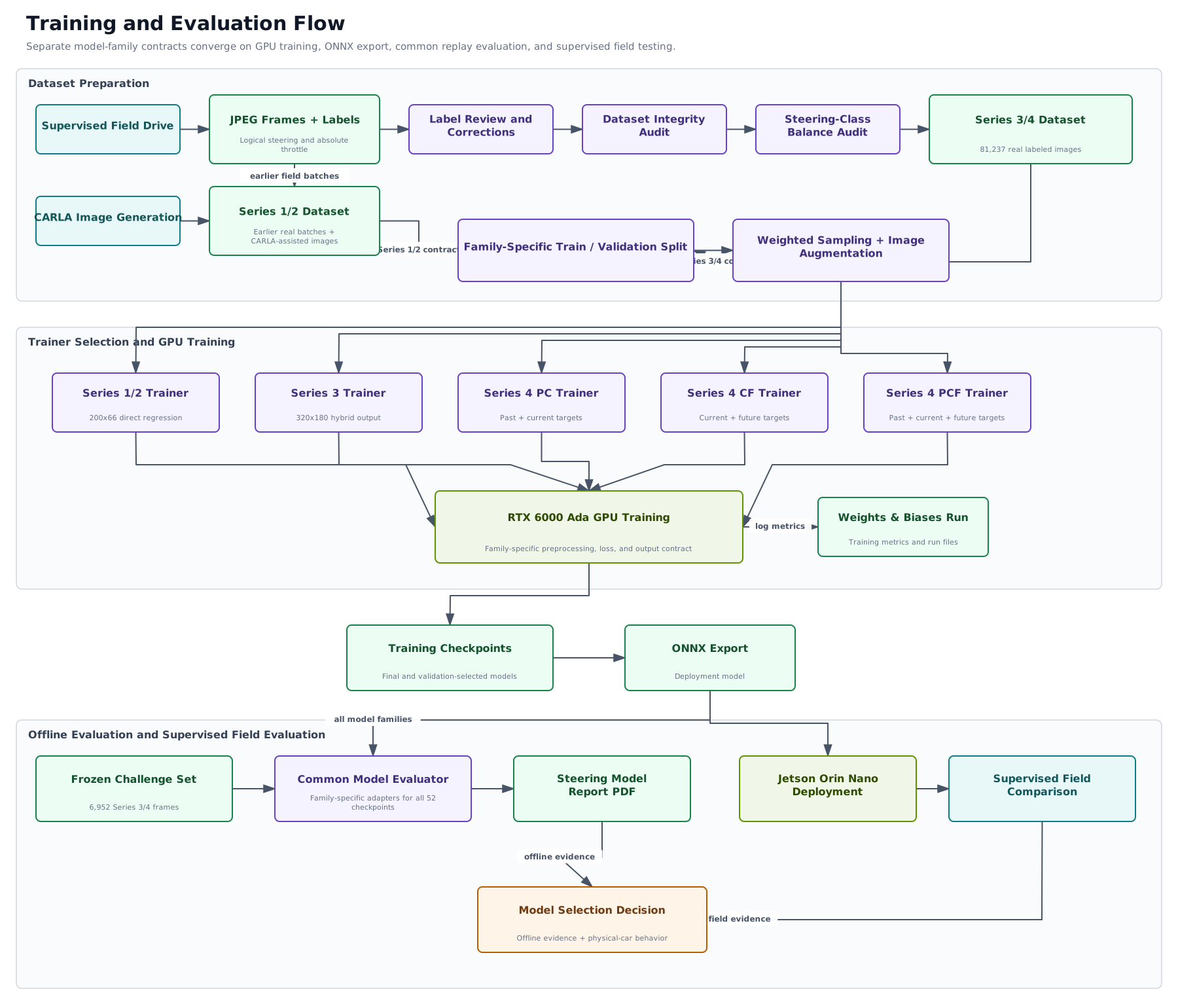
Training and evaluation flow. Open the full-size SVG or the editable draw.io source.
Series-Specific Trainers
| Family | Trainer | Input | Output contract |
|---|---|---|---|
| Series 1/2 | code/ai_models_datasets/series_1_and_2/sidewalkpilot_trainer.py |
200x66 | One direct steering-regression value |
| Series 3 | code/ai_models_datasets/series_3_and_4/series_3_sidewalkpilot_trainer.py |
320x180 | v3.0 two outputs; v3.1+ 19-value hybrid head |
| Series 4 PC | series_4_0pr_sidewalkpilot_trainer.py, series_4_1pr_sidewalkpilot_trainer.py |
image + three previous targets | one 18-value current steering horizon |
| Series 4 CF | series_4_0fg_sidewalkpilot_trainer.py, series_4_1fg_sidewalkpilot_trainer.py |
image | four 18-value current/future steering horizons |
| Series 4 PCF | series_4_0ac_sidewalkpilot_trainer.py, series_4_1ac_sidewalkpilot_trainer.py |
image + three previous targets | four 18-value current/future steering horizons |
Each family still needs its own preprocessing and output decoder. The common evaluator provides those adapters and scores all 52 checkpoints on the same frozen 6,952-frame Series 3/4 challenge subset. Series 3 and experimental Series 4 train on the same 81,237-image dataset.
Series 4 Temporal Comparison
Series 4 removes throttle learning and keeps the Series 3 visual backbone and nine steering bins. Every horizon is 18 values: nine class logits plus nine class-local offsets. Previous-target history is a causal runtime input for PC/PCF; future targets are training supervision for CF/PCF and are never runtime inputs.
The model names form six final/validation-selected pairs:
| W&B run | Final epoch | Best validation |
|---|---|---|
4.0pr |
4.0p |
4.0r |
4.0fg |
4.0f |
4.0g |
4.0ac |
4.0a |
4.0c |
4.1pr |
4.1p |
4.1r |
4.1fg |
4.1f |
4.1g |
4.1ac |
4.1a |
4.1c |
All six Series 4 runs completed 25 epochs and logged to the same W&B project. The twelve model names identify the final and validation-selected model from each run.
Labels
Training records use physical values:
- Steering: logical target from 0 to 180 degrees;
- Throttle: absolute physical PWM fraction from 0.0 to 1.0.
Runtime reference throttle is different. The car does not physically move below roughly 55%, so policy maps a useful reference range onto the physical range. Historical photo labels stay absolute so data collection remains honest and reversible.
Series 3 requires both a steering and throttle field in each accepted label, even when a run trains with --throttle-loss-weight 0.0.
Split Integrity
Consecutive driving frames are near-duplicates. Randomly distributing individual images would leak almost the same scene into both training and validation.
The trainer sorts images by path and groups them into 100-frame windows. Each window, including the final partial window when present, goes to training or validation, with approximately 10% reserved for validation by default. This keeps most neighboring frames together, although one capture run can still contribute different windows to both sets.
Sampling and Augmentation
The v3.4 and Series 4 runs used class-weighted focal loss, deterministic left and right balance flipping, lighting and color augmentation, and synthetic diagonal shadow bands.
More augmentation is not automatically better. v3.3/v3.3b increased shadow-hardening pressure but performed worse on the physical car. v3.4 shows why augmentation changes must still be tested on ordinary turns.
The 81,237-image dataset used for the current Series 3 and Series 4 runs contains real field images only. These runs did not use CARLA images or source weighting. Their samplers selected 50,000 examples per epoch without steering-bucket reweighting.
Series 3 Hybrid Loss
For v3.1 and later, the 19-value output is decoded into:
- A nine-way steering class;
- An offset within the selected class;
- Optional throttle.
Training combines focal-weighted classification loss, Smooth L1 loss for the true class's local offset, and optional Smooth L1 throttle loss. Current steering-focused runs set throttle loss to zero because 95.51% of the 81,237 throttle labels are full throttle. That distribution cannot teach useful variable-speed control.
Typical Steering-Focused Command
From code/ai_models_datasets/series_3_and_4/:
python3 series_3_sidewalkpilot_trainer.py \
  --roots sidewalkpilot_dataset \
  --model-version 3.0 \
  --epochs 35 \
  --flip-aug-probability 0.5 \
  --throttle-loss-weight 0.0 \
  --keep-pth
This is a documented training pattern, not a claim that every Series 3 release used identical flags. Reproducing a release requires its W&B configuration, dataset version, and exact model file.
The trainer uses AdamW. Important defaults include batch size 256, learning rate 3e-4, weight decay 3e-4, 320x180 input, 50,000 sampler draws per epoch, 10% validation, and ONNX opset 17.
Checkpoints and Export
Training produces two paired models:
- Regular: final epoch;
- Paired suffix (
b, or Series 4r/g/c): the validation-selected model from that run.
Both are exported to ONNX. PTH files are removed unless --keep-pth is specified. Recent runtime telemetry measured approximately 30 inference results per second on the Jetson Orin Nano, near the 30 FPS camera target; the exact rate depends on the selected model, software build, and power mode. The active field runtime does not require TensorRT or quantization.
Evaluation and Promotion
The evaluator at code/test_files/models/evaluate_sidewalkpilot_models.py produces the cross-checkpoint report. Current ranking considers:
- Balanced nine-class accuracy;
- Turn exact and turn within one class;
- Straight exact accuracy;
- Mean and median absolute error;
- Signed error and confusion patterns.
Field promotion then checks the model on ordinary left and right turns and the failure condition it was designed to improve. See Model Iteration Method and Series 3 Results.